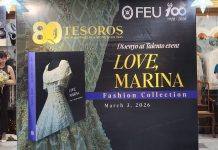




At the launch of Love, Marina at Tesoro’s, guests gathered not only for a book signing, but for a return to a particular vision of Filipina elegance. The monograph, penned by writer, culinarian, and designer Vicky Veloso-Barrera, honors her grandmother, the couturiere Marina Antonio, whose work helped define 20th-century Filipiniana. Through photographs, archival material, and personal essays, the book pieces together the life of a woman who shaped gowns with the same care that she set a table or tended a garden.
Marina was known for romantic silhouettes that respected the natural curves of the body. Her gowns were softened by fine embroidery and intricate beadwork. Terno sleeves were structured yet graceful. Brides sought her out for dresses that seemed to bloom from the waist and fall in gentle tiers. Over time, she dressed society women and expatriates, including Clare Boothe Luce and Jean MacArthur. Her work moved between private celebrations and larger historical currents, from pre-war Manila to the years after independence.

The book draws from family archives, period clippings, and material from the United States Library of Congress. Barrera writes in a personal tone. She recalls how a fitting at her grandmother’s Pasay home was never just about measurements. Clients were welcomed into the tropical mid-century house designed by Marina’s husband, National Artist for Architecture Pablo Antonio. They were served pork chop adobo sprinkled with parsley, candied camote shaped like confection, and full lunches prepared with care. Beauty, for Marina, was a complete experience. It included food, flowers, and conversation.
During preparations for the book, Barrera uncovered a hidden detail inside one of the vintage gowns. Beneath a layer of lace-trimmed organza lay sheer tulle scattered with sequins. The sparkle was meant to glow softly from underneath. It was not loud. It was not obvious. The discovery felt like a subtle lesson from her grandmother. Marina believed in restraint, and that craft should reveal itself slowly.
Born Marina del Rosario Reyes in Binondo in 1910, she learned resilience early. Her father left the family when she was young. Her mother taught her to sew, cook, and stretch a peso. The phrase “bueno, bonito, barato” guided her choices. In 1930, she and her sisters opened a dressmaking shop on Taft Avenue. Their Filipiniana designs gained a following. A first marriage ended painfully when her husband left, saying she could not bear children. She turned back to work. In 1938, she married Pablo Antonio. Together they built a family of six children and a home steeped in art and discipline. After Pablo’s death in 1975, Marina returned to dressmaking with renewed focus. She lived until 2006, spanning nearly a century of change.
Love, Marina also looks closely at technique. It explains her use of cañamazo to give terno sleeves their shape. It documents her hand-painted florals, hand-rolled satin roses, and sampaguitas fashioned from excess ribbon. The beadwork was precise. The embroidery was clean and balanced. One chapter is devoted to the brides she dressed across generations. Another lingers in her garden, once tended with the help of a Japanese gardener who quietly warned the family to leave before the occupation of Manila during the war.

In the section on recipes, Marina’s sinigang followed the traditional method, with fresh tamarind mashed by hand. Her husband favored salted dried milkfish served with pan-roasted tomatoes. Leftovers became bread pudding. Nothing was wasted.
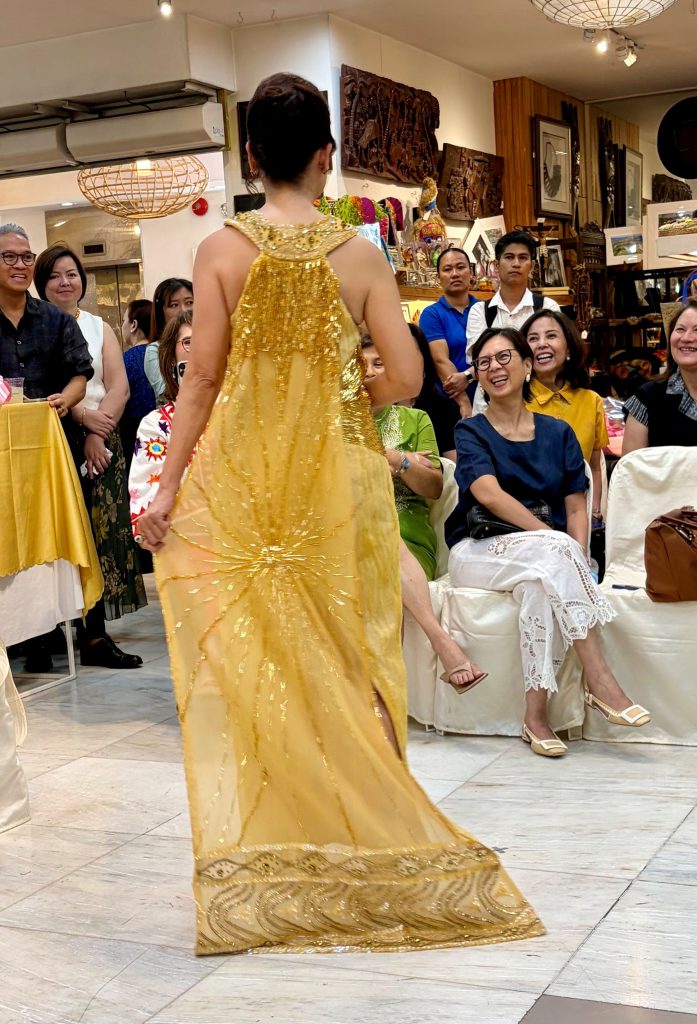
The launch itself became an extension of the book’s fashion theme. Staged as part of Tesoro’s Disenyo at Talento lecture series, the evening included a mini fashion show that traced four generations of designers. Vicky Barrera modeled a duo-tone gown from her grandmother’s archive, trimmed with cascading sampaguitas made from surplus satin ribbon. Malu Veloso, Marina’s daughter, presented streamlined silhouettes marked by delicate embroidery. Barrera’s sister, Letlet Veloso, offered a modern bridal look with a halter strap and a sheer skirt lined in nude. Fourth-generation designer Hannah Barrera created a yellow-gold gown worn by Marissa SyCip at her son’s wedding. The fabric was purchased in Paris 60 years ago. The beadwork patterns were inspired by the groom’s woodcut design, linking past and present in a single garment.
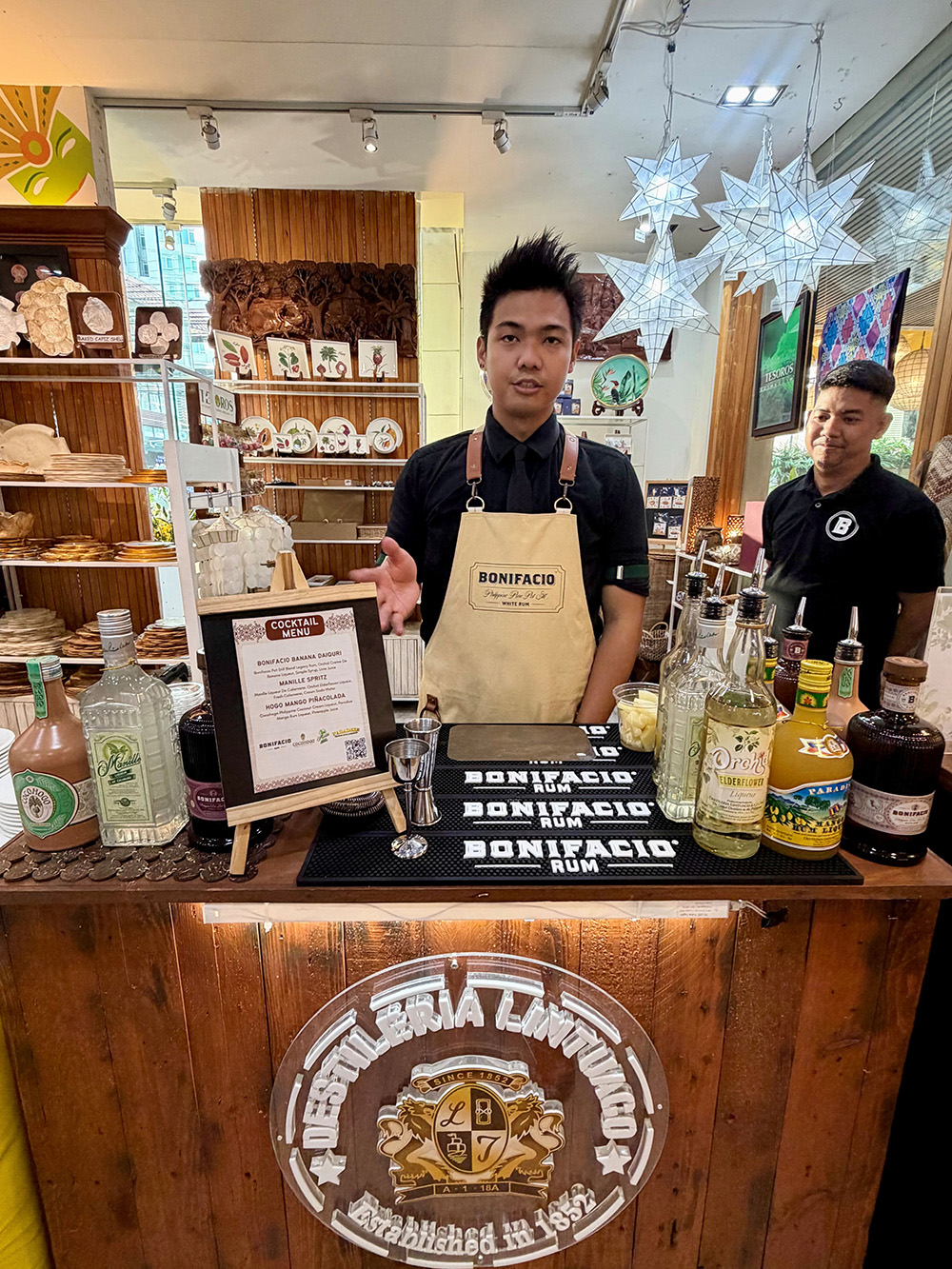
— proudly crafted by Destileria Limtuaco & Co., Inc., the oldest distillery in the Philippines.
Retailer Beng Tesoro described the event as a collaboration between the Veloso family and the store, which has long carried the work of the mother-and-daughter team Malu and Letlet. Many of their artisans have worked with them for decades. The oldest has been with Malu for 50 years. These artisans are the steady hands behind the fine beadwork and pristine embroidery that define the gowns.
Tesoro spoke about sustaining craftsmanship and honoring heritage. She noted that the store continues to highlight Filipino makers whose work reflects strong design and cultural memory. Among them is Destileria Limtuaco, the country’s oldest distillery at 174 years old, which served drinks during the reception.

Published by Far Eastern University Press, Love, Marina drew members of the academic community, including Far Eastern University (FEU) trustee Gianna Montinola and Dr. Rowena Capulong Reyes, vice president for corporate affairs. The evening also looked ahead to milestones. Tesoro’s recently marked its 80th anniversary. FEU approaches its centennial in 2028. Marina Antonio’s career began in the 1930s. These timelines converged in one room.
Ultimately, Love, Marina is not only about gowns. It is about continuity. It is about the women who cut patterns, stitch beads, and pass down skills on long tables. It is about a family that continues to design across four generations. And it is about the designer who believed that elegance begins at home, in the small, careful acts of making something beautiful and lasting.
‘Love, Marina’ is available at TAMS Bookstore at TamsBookstore@feu.edu.ph and Tesoro’s at 1016 Arnaiz Avenue, Makati City.